

We all say we want more focus. More joy. More calm. More presence with our own lives.
But we’re battling something most of us don’t even see anymore: constant digital stimulation.
Phones aren’t just tools – they’re tiny dopamine dispensers. We’ve trained our brains to chase micro-hits of reward all day long through refreshing, scrolling, tapping, checking.
And the result?
- 📉 Declining focus
- 😵💫 Overloaded nervous systems
- 😣 Emotional burnout
- 😴 Poor sleep and low mood
- 🧠 That foggy, scattered “I can’t think straight” feeling
The good news is..
Our brains are remarkably adaptable. They can recover – faster than you think. Recent research suggests that a 72-hour break from heavy smartphone use can create measurable positive changes in:
- mood regulation (hello serotonin)
- stress response
- executive function (decision-making + focus)
- motivation and reward pathways
- sleep quality and circadian rhythm
Not metaphorically. Biologically.
Why 3 days to rewire your brain?
Phones overstimulate the dopamine reward system. When it finally gets a break, you can rewire your brain because it recalibrates:
- ✅ More natural pleasure from non-screen activities
- ✅ Increased mental clarity
- ✅ Reduced anxiety and irritability
- ✅ Boosts in self-confidence and agency
Think of it as a reboot for your nervous system.
What happens during a smartphone reset?
Here’s what improves when we give our brains a weekend off with a smartphone reset:
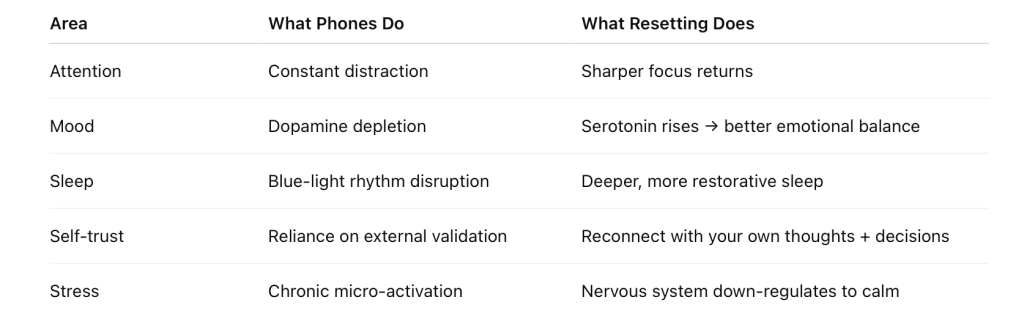
We don’t realise how tense we are until we finally relax.
How to try the 72-hour smartphone reset
Try this from Friday night → Monday morning:
- ✅ Turn off all non-essential notifications
- ✅ Move distracting apps off your home screen
- ✅ Put your phone in another room during rest times
- ✅ Replace scrolling with real-world dopamine (walking, cooking, reading, sunlight, journaling, seeing people)
And here’s the surprising part:
Most people don’t crave their phones nearly as much by Day 3.
Presence becomes enjoyable again.
How to notice the changes
At the end of each day, check in:
- Do I feel calmer or more restless?
- Is my mind quieter?
- Did I sleep better?
- Did I feel more in control of my time?
- Did I feel more connected to the world around me?
Your brain will show you what it’s been missing.
Less noise, more you
A smartphone break isn’t about restriction.
It’s about reconnection.
- To your body.
- To your people.
- To your creative mind.
- To the parts of you that get drowned out by the scroll.
Just three days is enough to remember who’s in charge.
📌 If you’d like a copy of my RESET72 guide – a guided approach to a 3-day reset for your mind and body, including the reflection prompts and boundaries checklist, you can download it here.
Sources and research
Emerging research shows that short-term reductions in smartphone use can positively impact mood, attention, and cognitive functioning. Studies indicate that excessive digital stimulation can dysregulate dopamine pathways, increase stress, impair sleep, and contribute to emotional burnout — while intentional breaks support neural recovery and improved well-being:
De-Sola Gutiérrez, et al. (2023) — Found associations between excessive smartphone use and anxiety, depression, and sleep disturbance, suggesting benefits from digital detox patterns.
Hadlington (2019) — Demonstrated cognitive improvements in attention and executive function after reducing smartphone usage.
Heid, M. (Time Magazine, 2018) — Reported measurable improvement in stress and mood after short-term smartphone reduction interventions.
Ting, et al. (2020) — Showed improvements in psychological well-being and reductions in emotional exhaustion when participants engaged in structured device breaks.
Berry & Westfall (2021) — Research linked smartphone abstinence to improved sleep quality and more stable circadian rhythms.
Duke University Center for Cognitive Neuroscience (2022) — Found that digital overstimulation suppresses natural dopamine regulation while phone-free periods can help restore reward system sensitivity.
More data is emerging in this rapidly growing research field, but early findings consistently show that even 72 hours of reduced smartphone engagement can support nervous system regulation, improved mood, and cognitive clarity
