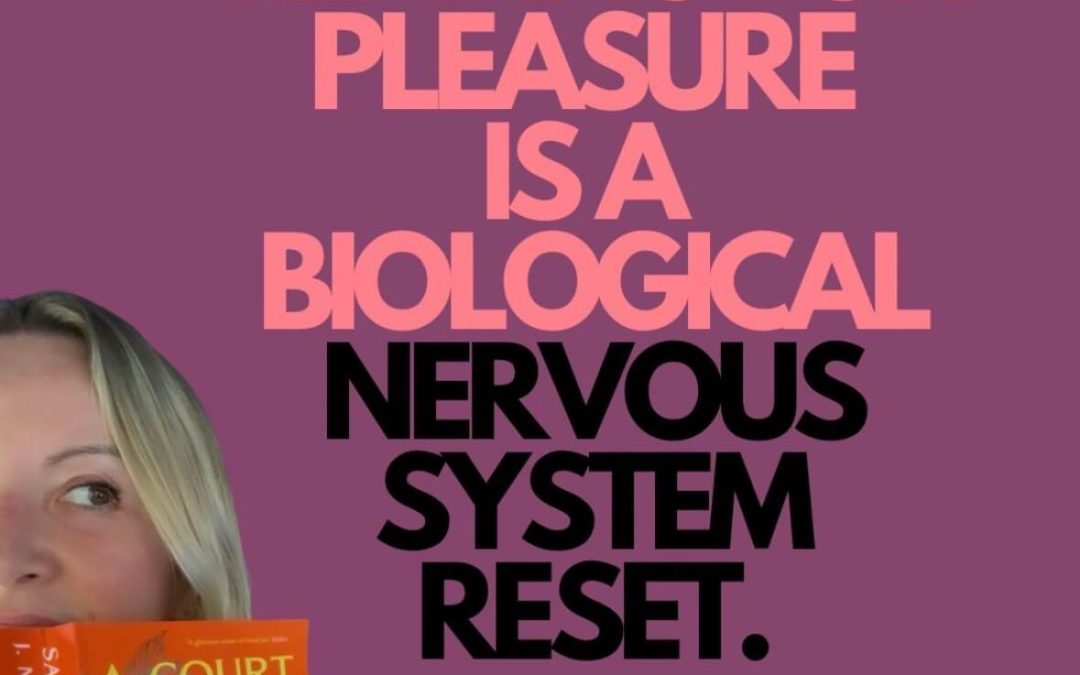
Reading for pleasure is not just a hobby. It is a biological nervous system reset.
When you read a book purely because you enjoy it, your brain doesn’t file it under “entertainment” or “self-improvement.” It reads it as something much more significant: a sustained shift in attention away from threat, urgency, and self-monitoring. In simple terms, you stop living inside your own internal noise for a while.
Most people underestimate how rare that actually is now. We live in a constant loop of input: messages, notifications, scrolling, updates, opinions, micro-stimulations that keep the mind slightly activated all day long. Even when we think we’re resting, we’re often still consuming, processing and half-alert.
Reading for pleasure interrupts that loop by creating what neuroscientists would describe as sustained attentional immersion. Your brain is no longer scanning for what needs doing next. Your predictive systems – those background processes constantly asking what could go wrong? – begin to quiet down.
And when that happens, something shifts in the body.
Your nervous system knows it’s safe
The nervous system receives a signal it doesn’t get very often anymore: nothing needs solving right now.
That signal matters because much of modern stress is not about acute danger. It’s about constant micro-activation. The sense that something is always pending, something always to respond to, something always to fix, check, or optimise.
Reading pulls you out of that state. Not by forcing relaxation, but by redirecting attention so fully that the system no longer has the bandwidth to stay on high alert. This is also why reading feels fundamentally different from scrolling. Scrolling increases stimulation and fragments attention. It keeps the nervous system slightly activated through novelty, comparison, and rapid switching.
Reading does the opposite because it deepens attention. It slows cognitive switching. It gives the mind a single thread to follow long enough for the system underneath to downshift.
The problem isn’t that we’re consuming too little information
It’s that we are almost never staying with anything long enough for our nervous system to settle into it. We’ve replaced immersion with interruption and stillness with input and presence with constant partial attention.
And the cost of that is subtle but cumulative: a baseline sense of agitation that we often misinterpret as stress, anxiety, or burnout, when in reality it is often under-recovery of attention itself.
Reading for pleasure is one of the simplest ways to restore that. Not because it is “productive self-care,” but because it gives the mind permission to stop performing.
You are not optimising, analysing or improving yourself – you are just there.
And that state – undistracted, absorbed, non-performative attention – is profoundly regulating for the nervous system.
Sometimes regulation looks less like effort, and more like letting your attention stay in one place long enough for your body to stop bracing. Like reading a book for no reason other than you enjoy it.
We’ve become so accustomed to constant input that we’ve forgotten what it feels like to simply get lost in something. Not consume it. Not extract value from it. Just be in it.
Your nervous system doesn’t experience that as trivial. It experiences it as safety.
If you’re ready to start working with your nervous system, instead of against it, book a free intro call and let’s chat.
